Inclusive and Resilient Addis Ababa – A Vision in the Making
Addis Ababa – An Inclusive City Pilot
The Global Disability Innovation Hub (GDI Hub) under the UK International Development-funded AT2030 programme and the Global Disability Fund’s (GDF) Resilient and Inclusive Cities Hub (RICH) has kicked off an inclusive city pilot in Addis Ababa, Ethiopia. Building on GDI Hub’s multi-year research in six cities globally on inclusive infrastructure, this two-year pilot project will further validate the gaps highlighted by ‘Inclusive Infrastructure and Cities: A Global Comparison Report’ and test recommendations from the ‘Delivering Inclusive Design in Cities: A Global Action Report’.
The AT2030 programme seeks to understand what works to mainstream AT access, and this workstream focuses on how inclusive cities and infrastructure contribute to an enabling environment for AT users to thrive. Our research so far has identified the importance localised approaches as well as the need for global action or a global movement for inclusive and resilient cities.
This blog outlines an overview of Addis Ababa’s context, how we are building local engagement, and the way forward in understanding what shapes inclusive cities.
The need for inclusive cities
Nearly 70 per cent of the world population is expected to be living in cities by 2050 (UN, 2018), including one billion people with disabilities (UCLG and WBU, 2024); a global study covering 520 cities finds that over 77 per cent of cities, by 2050, will experience major shifts in climate patterns (Bastin et al. 2019); and three-quarters of the urban infrastructure that will exist in 2050 is yet to be built (UN, 2021). These projections present a pressing need and an opportunity to co-design and implement inclusive and resilient urban infrastructure, services, and systems that will benefit all current and future urban residents, particularly persons with disabilities.
The findings of the Ethiopia Demographic Survey of 2024 that adopted the Washington Group questions suggest that in Addis Ababa, 17.7% of households include at least one person with a disability. This substantial population of persons with disabilities, however, are often excluded from the urban planning, design, and decision-making processes. The Addis Ababa, inclusive city pilot, aims to change this status-quo by co-designing and implementing a first-of-its-kind Inclusive City Action Plan in collaboration with Organisations of Persons with Disabilities (OPDs) and diverse city stakeholders.
Addis is Transforming Rapidly, but in Parts
Addis Ababa is the capital and largest city of Ethiopia, with over 4 million residents and a 527 sq. km geographic extent. As a chartered city and self-governing city-state entity, Addis Ababa has a unique administrative status and is serving as the region’s diplomatic hub, hosting the headquarters of the African Union and the UN Economic Commission for Africa. The city’s multi-year corridor development project, covering 40 km of streets in phase 1, is transforming the urban landscape rapidly with better sidewalks, cycling tracks, street lighting, and public green spaces. This has enhanced the safety, liveability, and functionality and has elevated urban aesthetics. With elements including tactile paving, dedicated bike lanes, regular mid-block crossings, and curb ramps integrated as part of redevelopment, persons with disabilities and AT users are gaining access to experience urban life safely and independently like never before, in parts of the city. 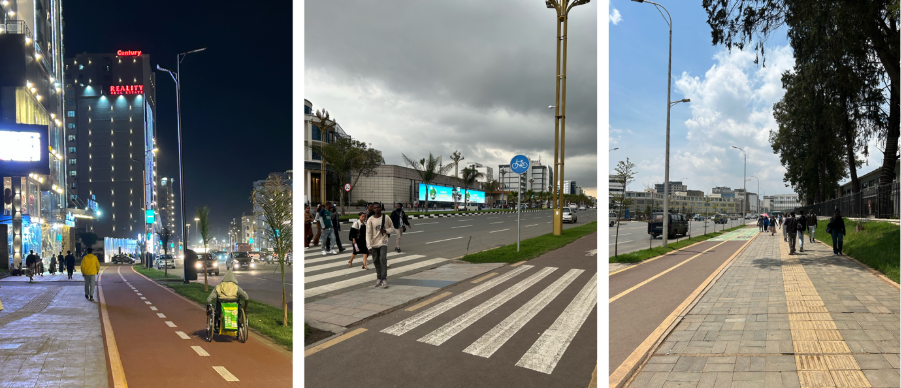
- Left image: As part of the Corridor Project, a separate, broad bicycle lane is provided, which is often used by persons with disabilities to navigate the pedestrian environment comfortably and easily.
- Middle image: Zebra crossing without a level difference for getting on to the pavement makes the travel journey for persons with disabilities obstacle-free.
- Right image: The pedestrian environment in the Corridor Project area has now been fitted with tactile way guidance to enable easy and safe access for persons with visual impairments.
However, GDI Hub’s preliminary stakeholder engagement and city site visits have revealed some gaps in design and detailing alongside construction shortcomings, which are potential physical barriers for maximising the benefits of this newly developed infrastructure.
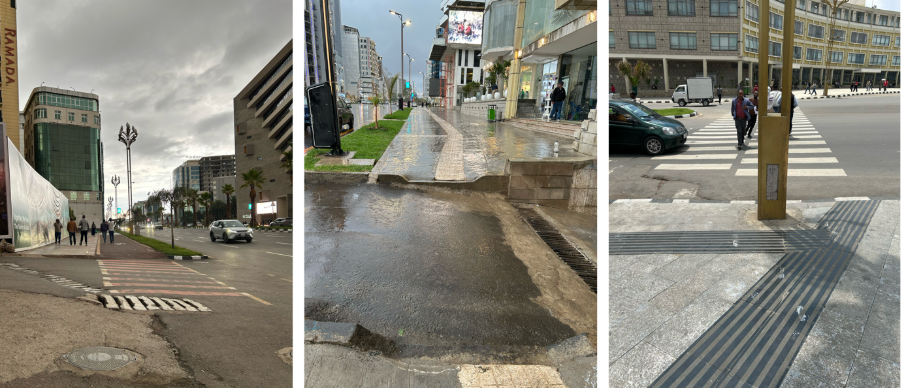
- Left image: The street crossings are not always accessible, with curb ramps provided only on one side of the street.
- Middle image: While the intention has been to provide curb ramps at all crossings in the Corridor Project area, the image highlights gaps in the implementation of the design guidelines, including poorly designed curb ramps.
- Right image: Incorrect laying of the tactile way guidance system, highlighting the design implementation gaps in the Corridor Project
Further, the development in its current form and process involves displacement and demonstrates stark inequality across the sub-cities of Addis Ababa. For example, the Piassa-Mexico-Sarbet-Gotera-Wollo Sefer corridor redevelopment, spanning 10.4 kilometres, is noted to have relocated over 14,000 residents as part of the street widening exercise. On the other hand, multiple studies indicate that 50–80 per cent of housing in Addis Ababa is informal, with neighbourhoods like Addis Ketema continuing to face challenges of inaccessible infrastructure, insufficient public transport connectivity, congestion, and poor urban health (Taye, Alemayehu & Woldeamanuel, 2025). In addition, the city is estimated to experience severe climate risks, with temperatures increasing by over 1.7°C between 2040 and 2060 and a rising frequency of drought and flooding. Global research shows that these climate impacts will have greater impacts on persons with disabilities (CBM Global, 2023)
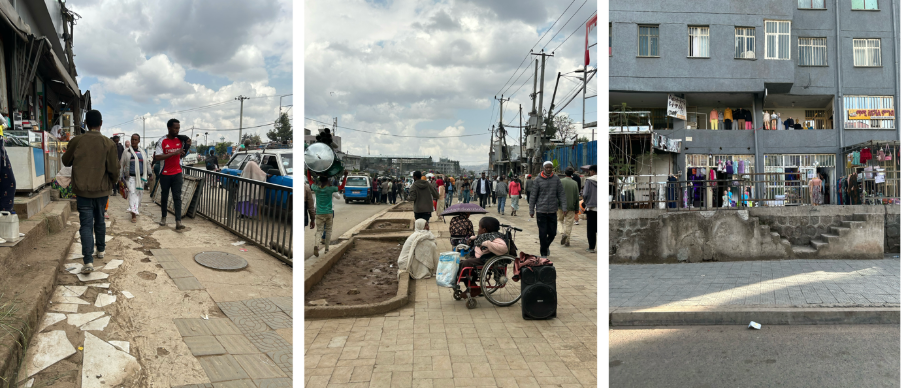
- Left image: Poor maintenance of the pavement and the tactile way guidance can defeat the accessibility they aim to enhance
- Middle image: Encroachment of pavements by street vendors, seen in places, reduces accessibility but also reflects the need for building operations and maintenance.
- Right image: Raised pathways and commercial access can be employed as a buffer for flooding resilience, but create accessibility barriers, as evidenced by the stepped access seen here.
Shaping Change Together: A Shared Voice and Vision
The Addis Ababa – Inclusive City Pilot Project will offer opportunities for city stakeholders to reflect on the existing gaps for inclusion and accessibility, promptly test new ideas within the upcoming phases of the corridor development and city infrastructure projects and adopt robust institutional mechanisms for driving long-term inclusive transformation. By centring inclusive design and equal participation and partnerships as guiding principles for city-making, GDI Hub is bringing together the diverse stakeholders of the city to consolidate the demand for disability inclusion and build a collective vision.
“GDI Hub’s Inclusive Design strategy sets out a holistic approach to ensure we are committing to inclusion throughout the project stages of urban infrastructure. Testing and showcasing ‘what works’ in Addis Ababa are a great opportunity for the city to be a global leader in disability inclusion and equal participation of AT users.”
Mikaela Patrick, Head of Research and Delivery, GDI Hub
As a first step, in March 2026, GDI Hub hosted a stakeholders engagement event “Building an Inclusive Addis Ababa: Stakeholder Dialogue on Accessible and Inclusive Urban Development”, which was attended by over 30 members from public sector agencies, academia, design practice, civil society organisations (CSOs), development agencies, international think tanks, and Organisations of Persons with Disabilities (OPDs).
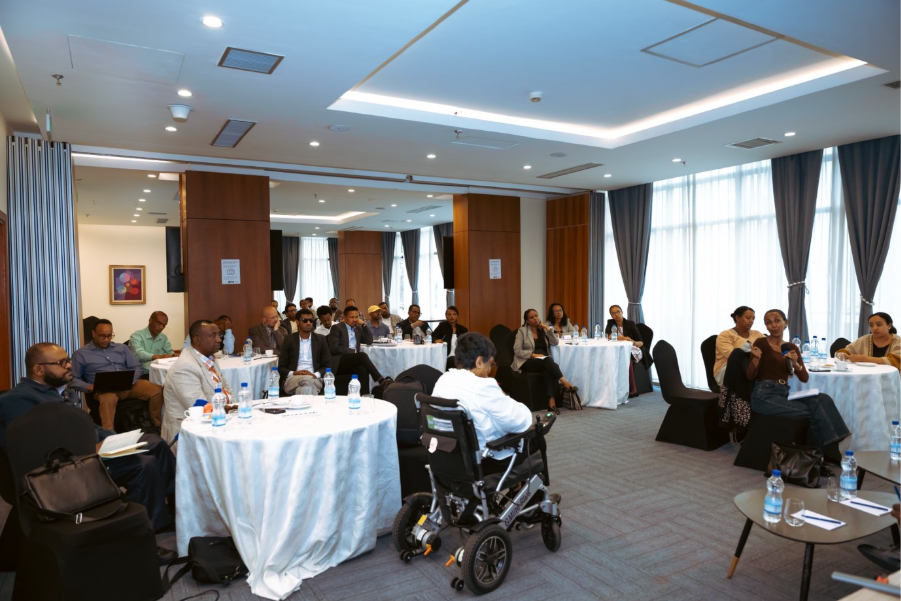
At the session, Shivani Gupta, Senior Inclusive Design Manager, GDI Hub, convened a panel discussion with Yosef Fekadu, Executive Director, Inclusive Ethiopia; Maheder Gabremedhin, Director, The Urban Centre; Sisay Tilahun, CEO, Disability Affairs, Ministry of Women and Social Affairs; and Mikaela Patrick, Head of Research & Delivery, GDI Hub. The discussion highlighted a range of messages, including the need for positioning infrastructure as a lever for social inclusion and empowerment, strengthening the investment case for accessibility, and putting in place accountability mechanisms across public and private sectors.
“We believe accessibility is a right, not charity, and we are working to make the physical environment accessible. This pilot project is very exciting, and we support both its implementation and everything needed to make it happen.”
Sisay Tilahun, CEO, Disability Affairs; Ministry of Women and Social Affairs
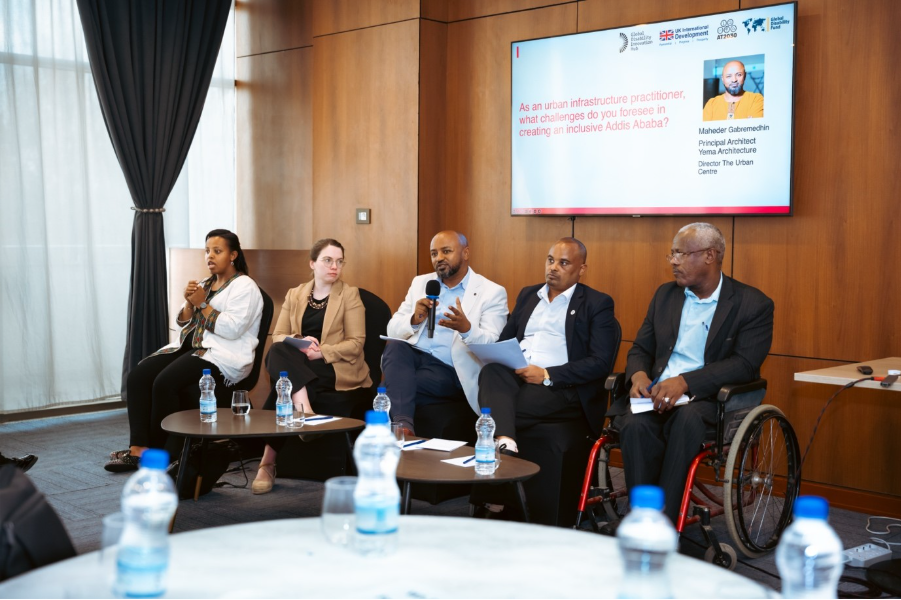
Image: Panellists respond to questions.
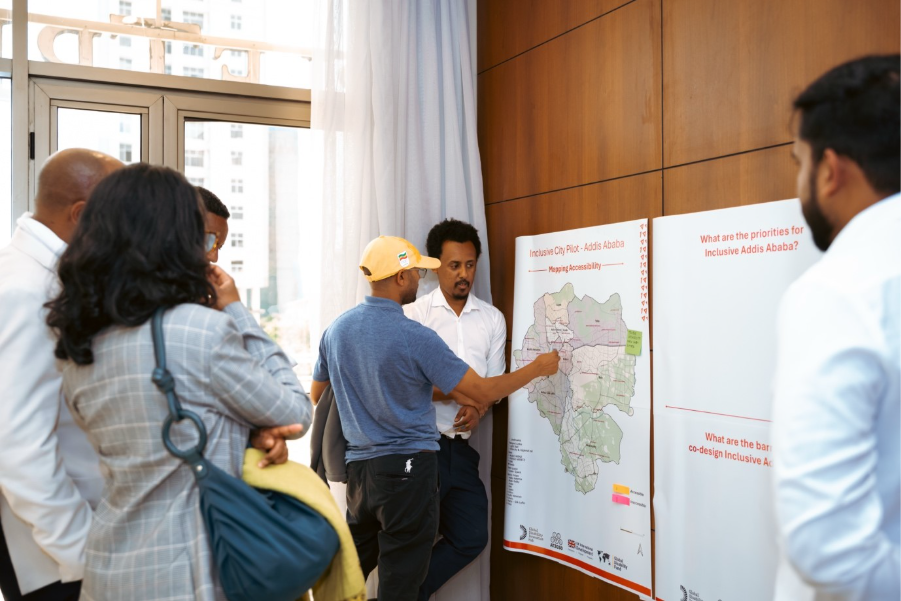
The stakeholders also shared insights through facilitated mapping activities and small group discussions, which focused on barriers to implementing accessibility, quick wins for disability inclusion, opportunities for engagement, and key priorities for action.
Way Forward
GDI Hub is now engaging with local partners to roll out a 6-month research and discovery phase for
- assessing the state of disability inclusion through participatory tools,
- garnering interest from stakeholders,
- developing an evidence-based action plan, and
- co-creating a theory of change for the implementation phase.
By centring the lived experiences of persons with disabilities in Addis Ababa and a transdisciplinary thematic lens covering gender inclusion, climate resilience, and financial inclusion, the discovery phase shall generate new data and knowledge. Research activities will include policy review, key informant interviews, surveys, focus groups, photo diaries, validation workshops, and geospatial mapping and analysis. The discovery phase will directly engage over 500 city residents and stakeholders.
The generated data with validation from city stakeholders will inform the preparation of a bespoke action plan for Addis Ababa with priorities identified for realising the inclusive city vision.
Call to Action
GDI Hub will be hosting ‘Living in Inclusive Cities - Accessible, equitable housing and the critical role of infrastructure’, a networking event on 19th May 2026, at the 13th World Urban Forum (WUF-13), Baku, Azerbaijan. Drawing on the sixteen priority action areas proposed through the global action report, the session will explore practical solutions for implementing Inclusive Addis Ababa.
If you are attending WUF-13, please add the event to your calendar, and we look forward to your participation.