Connection as Infrastructure and Resilience in the Transnational Disability Movement:
Organisations of persons with disabilities (OPDs, also called Disabled People's Organisations or DPOs) are often the actors who know where disabled people are, what they need, and whom they trust. Yet the connections between them as an ecosystem -- and between them and the institutions that fund and work with them -- still run mostly on word of mouth and one-off consultation. This paper draws on a webinar launching The Global DPO/OPD Map, hosted by the Global Disability Innovation Hub (GDI Hub), where GDI Hub hosted the curator of the Map, two OPD leaders, and a UNICEF adviser to discuss how the movement connects, what stops it, and what it needs from others.
The core learning from this event is that connection is infrastructure and enables resilience. Relationships built day-to-day are what make coalition funding bids, rapid disaster response, and credible policy engagement possible. In this way, a connected movement is a resilient movement. The panel showed that this infrastructure is being built largely by OPDs themselves, under shrinking funding, while the procedures and assumptions of larger institutions can work against them.
Three headline calls to action follow:
- Fund connection, not just projects: Coalition-building, pan-disability networks, and the tools that support them (including The Global OPD Map) need core, multi-year funding.
- Build relationships before crisis: Government, humanitarian, and development actors should identify and partner with OPDs as a standing part of preparedness, not just during responses to ever-increasing political and climate-driven crises.
- Change the terms of partnership: Multilaterals and mainstream movements should treat OPDs as direct partners, with fair pay and accessible, safe spaces, rather than as subcontractors or consultees.
Context
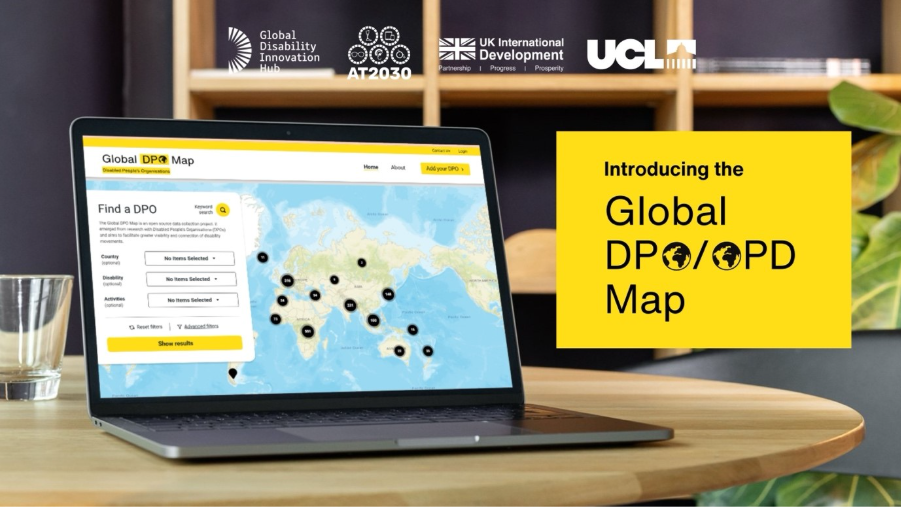
The Global DPO/OPD Map is a free, open-source map of advocacy groups led by disabled people, built at GDI Hub (UCL) under the AT2030 programme, which is funded by UK International Development. At the time of the webinar, the Map hosted more than 2,000 organisations, which we believe is the largest documentation of its kind in the transnational disability movement. Organisations add themselves through vetted submissions; contact details are available, and the resource is public and free of cost. The site is available in English, Spanish, French and Arabic, with Easy Read guides, and has been tested for screen reader access. Planned additions include OPD news and blogs, funding resources, more languages and a data visualisation of the movement.
The Map exists because OPDs face real barriers to being visible (many have no web presence or communications capacity), and because funders, partners and other OPDs have few ways to find them other than word-of-mouth – limiting proper engagement and mainstreaming of disability inclusion. The panel was chosen to reflect both sides of that need:
- Patience Ogolo-Dickson, co-founder and Executive Director of Advocacy for Women with Disabilities Initiative (Nigeria), African representative of the Commonwealth Disabled People's Forum, and West Africa coordinator for Disabled Women in Africa.
- Germán Parodi, Director of The Partnership for Inclusive Disaster Strategies, a US-based, disability-led organisation working on disasters across all impairments and all hazards.
- Priyanka Narahari, consultant with UNICEF, working on engagement with OPDs in emergency preparedness.
The session was chaired by Anna Landre (GDI Hub), Curator of the Map, with an introduction from GDI Hub's Director of Global Engagement, Louise Gebbett.