GDI Hub's work to build a funding system that works for disability led impact
A project delivered by GDI Hub in partnership with Organisations of Persons with Disabilities, funded by the UK International Development AT2030 programme.
Localisation
“Our common future depends on all money eventually aligning with sustainable development that benefits people and the planet.” United Nations, Financing for Sustainable Development
In international development, ‘localisation’ efforts promise the shifting of funding and authority to those within – and most closely connected to the priorities of – affected communities. Ranging from national (even multi-national) umbrella to informal and hyper-local, Organisations of Persons with Disabilities (OPDs), also called Disabled Persons Organisations (DPOs), are civil society/third-sector representative organisations that exist for the explicit purpose of advancing justice as it pertains to the disability community1.
Indeed, it is underpinned by the directive of the United Nations Convention on the Rights of Persons with Disabilities (CRPD) that OPDs should be central to States advancing disability rights and driving more equitable outcomes. And while the CRPD does not create legal obligations for non-state actors such as donors, funders, businesses, international organisations, or NGOs, many global frameworks call on these actors to align their work with CRPD principles and to work in partnership with OPDs.4,5
GDI Hub also positions that when funders commit to localisation and equitable partnership, engaging OPDs in line with the CRPD becomes an expected element of responsible funding practice; not just to align with the CRPD but as doing so can lead to more relevant, contextually appropriate outcomes.
More on the CRPD: The CRPD requires states to closely consult and actively involve persons with disabilities through their representative organisations in all legislation, policies, and decisions that affect them. It also affirms that unrestricted, sustainable funding for OPDs is a precondition for their effective participation and for realising the right to freedom of association.
Minimal funding
If OPDs are shape the decisions that affect the lives of the communities they represent, funding must flow in ways that make that possible. However, current funding structures and practices of remunerating OPDs are often at odds with OPDs being able to do so.6
Despite the stated importance of their meaningful participation in disability inclusive development, many OPDs operate with minimal and insecure funding, undermining their ability to sustain operations, be involved in, and have influence over the shaping of strategies, policies, interventions, and decision-making.7
This challenge is multifaceted, with no single fix. OPDs are diverse, and the expectations placed on them – be that from intermediaries or direct funders- often don’t align with their realities, priorities, capabilities or operating models. At the same time, funders face systemic restrictions and requirements that shape how they can allocate resources.
The pool of funding for disability‑inclusive development has contracted, which makes it even more important to understand and remove the barriers that prevent OPDs from accessing resources required to participate in development that affects disabled people.8,9
Why the AT2030 programme?
As organizations rooted in lived experience and local networks, OPDs can be well placed to identify needs, support appropriate AT provision, and connect individuals to services, training, and peer support. However, when OPDs themselves are under-resourced, their capacity to bridge the AT access gap is constrained.
AT2030
Under the UK International Development Funded AT2030 programme, GDI Hub is prioritising this challenge by identifying where funding systems block OPDs from participating and determining how those barriers can be dismantled so OPDs can play a central role in shaping legislation, policies, and decisions affecting persons with disabilities.
Phase 1:

The project began with investigating the drivers of insufficient funding reaching OPDs for their meaningful engagement in disability-inclusive development work that affects them and the communities they represent. In partnership with 8 OPDs representing communities in Africa, Asia and the Pacific, we set out to map the current funding environment for OPDs in low- and middle-income countries (LMICs): identifying where financial resources come from, how they arrive at OPDs, what stands in the way of access, and opportunities to remove these barriers. This resulted in the publication of a funding landscape review, ‘Pathways to Funding For Organisations of Persons with Disabilities in Low- and-Middle-Income Countries’.
We found that that practices and challenges on both the OPD and funder sides contribute to inefficiencies, which informed recommendations for both funders and OPDs to improve funding pathways for OPD participation. We find that OPD funding challenges can mirror those seen across civil society, but OPDs also face distinct barriers, for example, budgeting for reasonable accommodations being viewed by certain funders as optional rather than required.
- We also published a ‘Good Practice Guidance from & for Organisations of Persons with Disabilities (OPDS) in Low-Middle Income Countries (LMICs)’ which offers OPDs’ experiences, practices, tips, and tools for other OPDs to use to improve their practices and build their funding pipelines.
Finally, four OPDs in Sierra Leone, Tanzania, Kenya, and Ethiopia took forward the amplification of the two publications as suited to their priorities and local context; with which OPDs delivered for example, workshops, policy briefings, videos and report translation.
Tanzania Users and Survivors of Psychiatry Organisation (TUSPO) for example, met with OPDs and policy stakeholders from across Tanzania’s disability funding ecosystem, informing key messages for a policy advocacy position that TUSPO took to the National Disability Advisory Council.
Phase 2:
As of August 2026, we now enter the second phase of the project’s delivery, within which we seek to translate the Landscape Review into practice by testing and demonstrating findings and recommendations that expand OPD access to funding.
For this phase, GDI Hub are partnering with Nothern Nomadic Disabled Persons Organization (NONDO), Kenya, and Welfare Society for the Disabled – Sierra Leone (WESOFOD-SL) to co-develop and deliver interventions that will:
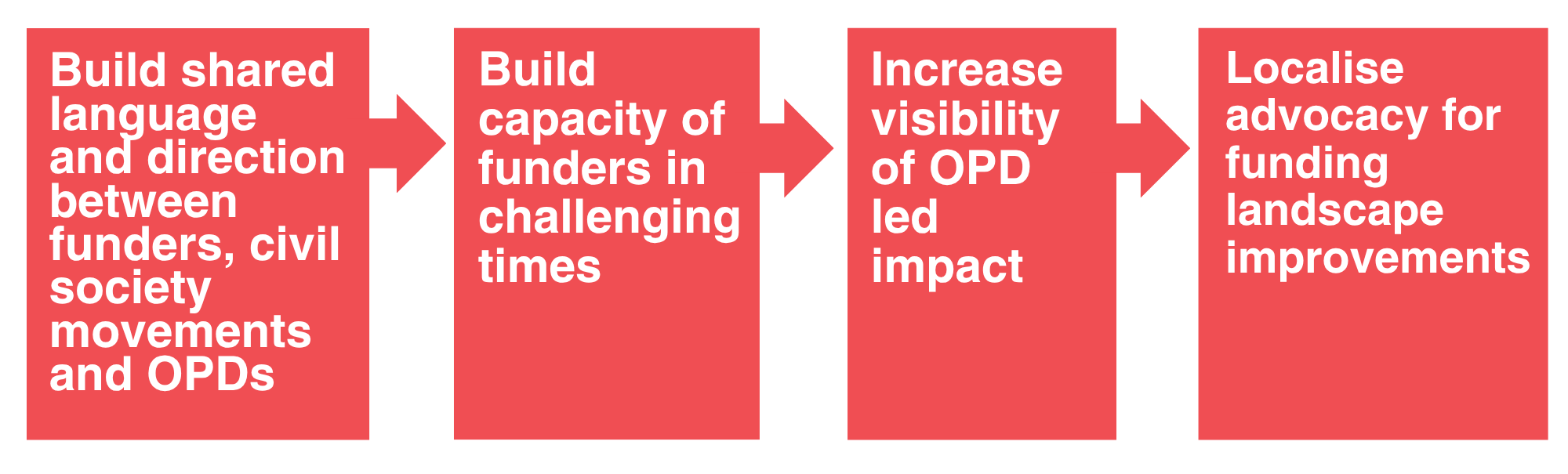
Over the coming year, we will be:
- Bring together funders, OPDs, civil society to form a shared language on the real operational pressures and barriers, and define what individuals and organisations can commit to, to strengthen the system.
- Publish a complementary Guidance; From Funders, For Funders; sharing practices, tips, and tools for other Funders to use; relevant today, when the system is still imperfect.
- Document and publish evidence on the OPD-led disability inclusive development impact, such as advancing access to assistive technology.
- Continue to fund the localization of constructive dialogue, capacity building and advocacy.
Publications to date:
Phase 1:
Reports:
Local Amplification Activities:
Acknowledgements: