From Testing to Community Ownership: Kenya's Smart Mobility Project Enters Its Next Phase
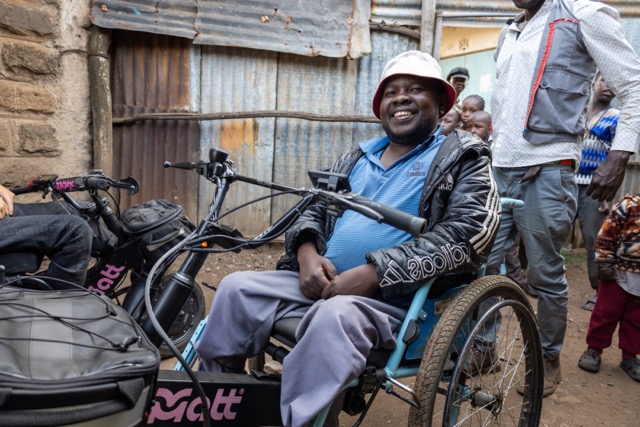
In the informal settlements of Nairobi, wheelchair users are testing technology that could fundamentally change their lives. Kenya is home to approximately 400,000 people living with mobility impairments, many of whom face daily battles with deteriorating roads, limited accessible public transport, and infrastructure that wasn’t designed with them in mind. But a pilot project called Smart Mobility is exploring whether a simple innovation – a detachable electric “third wheel” for wheelchairs – could help break down these barriers.
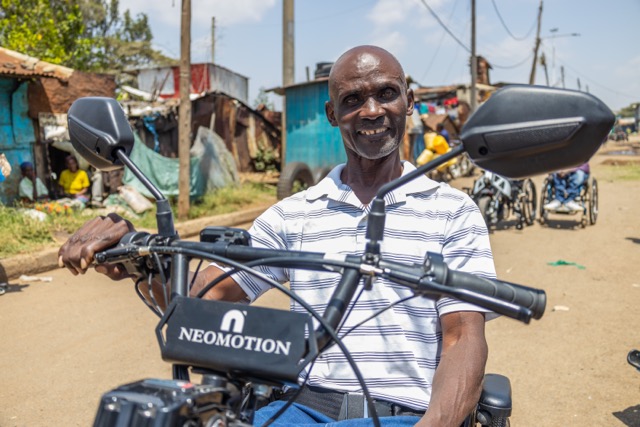
A detachable electric third wheel is a powered attachment for manual wheelchairs that converts them into a three-wheeled electric tricycle (trike). This assistive technology attaches to the front of a standard wheelchair, providing a powered, steerable wheel that allows the user to travel faster and over rougher terrain without needing an assistant.
The idea originated with FCDO Pioneers Anne MacKinnon and Dr. Jacqueline Owigo, who asked if a product that has proven successful in India and Colombia could work in Nairobi. And more importantly, can it be adapted to meet the specific mobility needs of Kenyans living with disabilities?
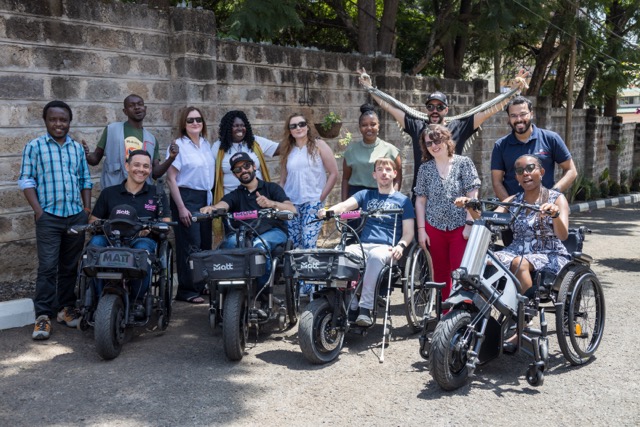
Led by the Global Disability Innovation Hub (GDI Hub) in partnership with the Frontier Tech Hub and funded by UK International Development, the initiative has assembled a consortium of innovators: MATT from Colombia, NeoMotion from India, and local Kenyan partners including EbikesAfrica, Jionee (an Organisation of Persons with Disabilities, or OPD), and Kounkuey Design Initiative (KDI). Additionally, the AT2030 programme provided additional support for this global exchange of ideas and expertise.
In the initial pilot, which took place in 2025, early collaborative workshops identified and explored four critical themes that would guide the project. The first was testing whether the existing devices from India and Colombia could be transferred to the Kenyan context, or whether modifications were necessary to handle the rough terrain and road conditions in Nairobi. Accessibility and affordability formed the second pillar, focusing on developing new financing models such as rent-to-buy schemes or linking device ownership to income-generating opportunities. The third theme centred on user needs and experiences, including understanding biometric differences, the variety of wheelchair types in use, and whether the devices were suitable for the specific context of Kenyan users. Finally, collaboration and co-design ensured that local groups, NGOs, and government bodies remained engaged to guarantee solutions would be relevant and scalable.
These principles transformed from workshop talking points into practical considerations as the project moved to its most crucial phase: real-world testing.
Two Workstreams: Hub and Device Development
Following the successful pilot, this project has been extended along two distinct workstreams.
Workstream 1: The Community Device Hub
The first workstream tests the feasibility of a community device hub for wheelchair mobility devices in Kenya. The goal is to generate practical evidence on what is required for such a model to function effectively and potentially scale sustainably, with appropriate institutional and local organisational capacity and ownership.
The hub will operate through Jionee, an Organisation of Persons with Disabilities led by Herman Lihanda. Jionee is a community-based organisation that works on a membership model: its members have built trusted relationships with the organisation over time. Through the hub, members will be able to rent devices at 200 Kenyan Shillings per day. The hub is designed to create two streams of value: individuals can rent devices to take advantage of job opportunities or for personal mobility, and the organisation itself will work to identify revenue-generating opportunities – such as advertising on the wheels, working as stewards at events, or exploring tour-based activities. Revenue from both individual rentals and organisational activities will feed back into the hub’s operations, with any surplus going towards purchasing new devices or directly supporting members.
All partners play an equal and vital role in making this hub work. EbikesAfrica serve as technical partners, responsible for setting up the hub, delivering training, and providing ongoing technical support throughout the pilot. Jionee, as the host OPD, runs the day-to-day operations of the hub, with its members at the centre of the initiative. KDI supports hub operations and in-country monitoring and evaluation, while also providing feedback on the hub’s long-term sustainability.
Workstream 2: Device Affordability and Local Assembly
The second workstream, led primarily by EbikesAfrica, focuses on the affordability and contextual relevance of the device itself. This includes exploring what a Kenya-based manufacturing or assembly model might look like, investigating supply chain options, and assessing how the device could be made more affordable while being assembled in-country. The aim is to develop a pathway for scaling upwards with a locally grounded, cost-effective approach.
The Pilot in Practice
The pilot will explore operational, financial, governance, and inclusion considerations through a co-designed, time-bound implementation over four weeks. The model is intentionally designed to be locally appropriate and inclusive, ensuring that the community remains at the centre of decision-making.
The team will co-design a locally appropriate and inclusive community device hub model that reflects the needs and capacities of Korogocho residents, and pilot the hub using four devices over four weeks to test real-world functionality.
During this period, the project will assess user experience, demand, affordability, and operational viability. Understanding institutional, staffing, and financing requirements for sustainability will be essential.
The project structure itself reflects this community-centred philosophy. It’s intentionally light-touch, designed to enable delivery partners to lead day-to-day operations while ensuring robust oversight, safeguarding, and accountability. This approach recognises that sustainable solutions must be owned and operated by the communities they serve, rather than imposed from outside.
The overall aim is ambitious but clear: to produce practical, decision-grade evidence and investment-ready outputs that enable local partners to lead the next phase, whether that’s implementation or scale. This includes a proven community device hub model and a locally grounded device feasibility pathway.
What makes this approach distinctive is its commitment to community leadership from the start. By partnering with an established OPD and ensuring that local voices drive the design and implementation, the project isn’t just testing technology – it’s testing and refining a model for community ownership of assistive technology solutions. With EbikesAfrica providing the technical backbone, KDI strengthening the evidence base, and Jionee anchoring the initiative in the community, each partner brings something essential to this shared endeavour.
We are excited for this next phase and look forward to working alongside EbikesAfrica, Jionee, Kounkouey Design Initiative KDI, and all our partners on this FCDO-funded initiative.