Identification of Wheelchair Spare Part Needs through User-Technician Participatory Co-Design Session o
Users and technicians co-identify priority wheelchair spare parts in Nepal
On 12 October 2026, wheelchair users and technicians from across Nepal ranked the 12 spare parts they most need to keep wheelchairs moving. Pneumatic tubes and tyres and bearings came out on top. The participatory co-design session took place at the Centre for Disabled Children Assistance (CDCA) in Kapan, Kathmandu. It was run under the AT2030 programme, led by the UCL Global Disability Innovation Hub (GDI Hub) and funded by UK International Development, with CDCA, Makerko and the National Innovation Centre (NIC).
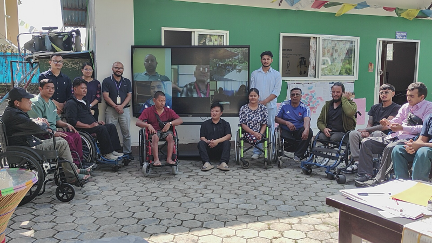
Participants at CDCA Kapan, with partners from Koshi, Gandaki and Karnali joining on screen.
Why spare parts?
A wheelchair is only as useful as its weakest part. AT2030 research in Nepal found that broken footrests, armrests and bearings often leave chairs unusable. Many imported chairs have no locally available spare parts, and some users simply store a broken chair at home (Thapa et al., 2025)[1]. One technician put it plainly: "Whatever wheelchairs are brought in from Japan or Germany, their spare parts are not available in Nepal."[2] The same study recommended low-cost local innovation for frequently damaged parts. This session was the first step towards doing that: asking the people who use and repair wheelchairs every day what should be made first.
Nothing about us without us
The session was hybrid. Seventeen people signed in on site: wheelchair users, wheelchair technicians, CDCA staff and the GDI Hub/Makerko/NIC researchers (14 men and 3 women). Seven other participants (6 men and 1 women) from the Rehabilitation and user organisations from three provinces (Koshi, Gandaki and Karnali) joined through a WhatsApp group call.
Remote participation brought in repair experience from outside the Kathmandu Valley, where AT2030 research found spare parts and repair services are hardest to reach (Thapa et al., 2025).
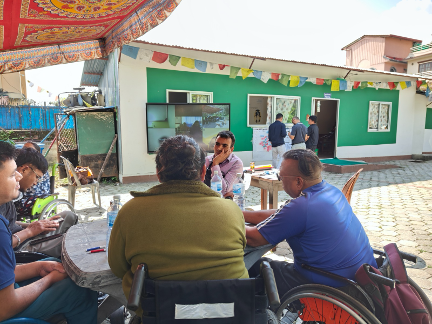
Remote participants joined via a WhatsApp group call shown on a large screen.
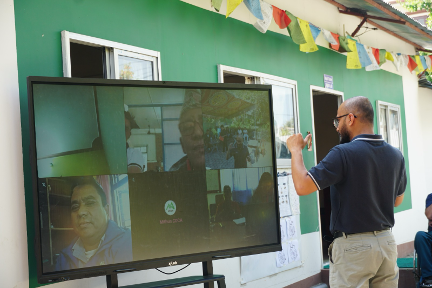
Users and technicians sharing breakdown and repair experiences.
How the session ran
The session moved from shared experience to a shared decision in five steps:
- Facilitators opened with why appropriate wheelchair service provision matters, drawing on the WHO wheelchair provision guidelines (WHO, 2023).[3]
- Experience sharing. Users and technicians described their own breakdowns, what repairs cost them, and where they could or could not find parts.
- Paired listing. Users worked in pairs to list the spare parts they most often need, based on their own use and service experience.
- Mapping on a wheelchair. Facilitators placed each part on a large wheelchair diagram on chart paper using labelled sticky notes. This gave everyone, on site and online, one shared picture of where chairs fail.
- Nominate and vote. Users and technicians discussed the map together and nominated 12 priority parts. Each participant then rated every part from 1 (low) to 3 (high), and the ratings were added up to give each part a total score.
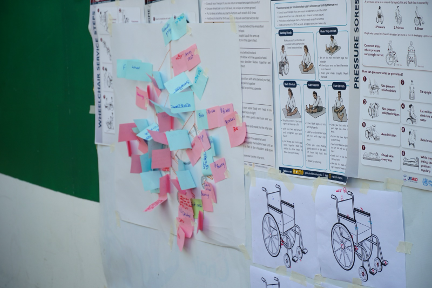
Spare parts mapped onto a wheelchair diagram with labelled sticky notes.
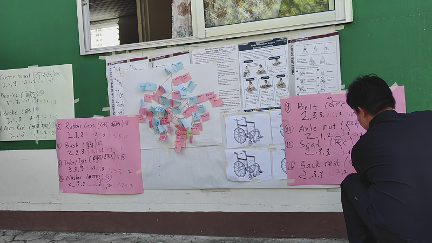
Participants' 1–3 ratings for each nominated part, recorded on chart paper.
What users and technicians prioritised
Tubes and tyres for pneumatic wheels and bearings tied for first place with 37 points each. Castor wheels (34) and back rests (33) completed the high-priority group.
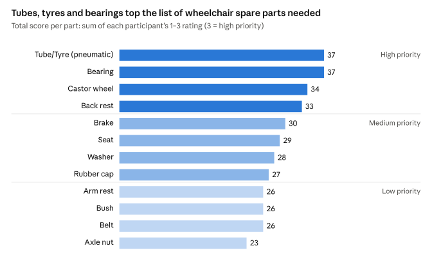
The list matches the weak points reported in wheelchair studies from Kenya and Nepal, where castors, bearings, seats and brakes fail early (Reese & Rispin, 2015; Thapa et al., 2025)[4]. It also highlights small items such as washers, rubber caps, bushes and axle nuts. They are cheap to make, but a missing one can stop a chair just as surely as a broken wheel.
What happens next
The ranked list now becomes the project's design brief. Using local production capabilities, the project team aims to produce 3 universal spare parts that fit many wheelchair models and around 10 custom components. These parts will reach users through a national network of wheelchair repair hubs that is already in place.
Building on a national repair hub network
The spare parts work builds on an earlier project. A Royal Academy of Engineering Frontiers seed-funding award (Inclusive Innovation in Action) supported Sundar Dhoka Saathi Sewa (SDSS) and CDCA, with Zener Technologies, to set up wheelchair and mobility repair hubs across all seven provinces of Nepal (Royal Academy of Engineering, 2025). CDCA announced the network of seven professional repair, maintenance and service hubs in October 2026 (CDCA, 2026).
The same project trained wheelchair and assistive technology users to become certified technicians and repairers. Training followed the WHO Wheelchair Service Training Package – Basic level (WHO, 2012) and ISWP basic wheelchair service certification, with technical support from Motivation India. This project will equip the same hubs for sustainable repairs, using spare parts and repair strategies developed in Nepal rather than imported parts that are often unavailable.
The plan: from priority list to parts on the shelf
The work runs in four phases, each feeding the next. A part moves to the next phase only when it passes the gate.
Phase 1: Co-design challenges. NIC engineers, CDCA and GDI Hub/Makerko researchers will turn each priority part into a design brief. They will then run co-design challenges with young engineers and designers from local universities to create universal spare parts and custom components. Every design will be made with local processes in mind. Designs move forward when they are practical to make in Nepal and fit the wheelchair models most common in the hubs.
Phase 2: Prototype and lab test. NIC and makerko will work with local fabricators to build prototypes using 3D printing with engineering filaments, laser and CNC cutting, injection moulding and mould making, and conventional workshop fabrication. Load-bearing components will be lab-tested using methods based on the ISO 7176-8 static, impact and fatigue tests (ISO, 2014). Only parts that pass these tests go on to users.
Phase 3: User–technician evaluation. Successful parts will be taken to certified user-technicians at the repair hubs for fitting, feedback and user evaluation in everyday use. The designs will then be refined. A part is ready for production once users and technicians accept its fit, durability and ease of repair.
Phase 4: Local production and roll-out. Final designs will be shared through a distributed, multi-maker network powered by makerko digital manufacturing platform. Workshops outside Kathmandu can then produce parts close to the people who need them. The repair hubs will stock and fit the parts and log each repair. The phase is complete when 3 universal spare parts and around 10 custom components are available through the hub network.
Repair records from the hubs will show which parts fail, how often and where. That evidence will guide the next round of designs and help make the case for including spare parts in public wheelchair procurement.
By putting users and technicians at the start of the design process, the project aims to make repair part of wheelchair provision rather than an afterthought. That is a gap identified in research on assistive technology repair in low-resource settings (Oldfrey et al., 2023)[5].
Acknowledgements
This work is funded by UK International Development through the AT2030 programme, led by the UCL Global Disability Innovation Hub. We thank UK International Development and the AT2030 programme for their funding and global support. We also thank every wheelchair user, technician and partner organisation who shared their time and experience.
References
- Centre for Disabled Children Assistance. (2026, October 2). Wheelchair repair hub information and contact details. CDCA. Link
- International Organization for Standardization. (2014). Wheelchairs — Part 8: Requirements and test methods for static, impact and fatigue strengths (ISO 7176-8:2014). BSI listing
- Oldfrey, B., Holloway, C., Walker, J., McCormack, S., Deere, B., Kenney, L., Ssekitoleko, R., Ackers, H., & Miodownik, M. (2023). Repair strategies for assistive technology in low resource settings. Disability and Rehabilitation: Assistive Technology. UCL Discovery
- Reese, N., & Rispin, K. (2015). Assessing wheelchair breakdowns in Kenya to inform wheelchair test standards for low-resource settings. RESNA Annual Conference. PDF
- Royal Academy of Engineering. (n.d.). Seed funding awardees: Inclusive innovation in action [Bikash wheelchair / mobility AT repair centre, Nepal]. Frontiers programme. Link
- Thapa, R., Oldfrey, B., Thapa, A., Holloway, C., Shrestha, P., & Gowran, R. (2025). Wheelchair provision in Nepal: Biratnagar, Koshi Province. AT2030 Integrate, Global Disability Innovation Hub. PDF
- World Health Organization. (2012). Wheelchair service training package – Basic level. WHO. Link
World Health Organization. (2023). Wheelchair provision guidelines. W