Publications
-
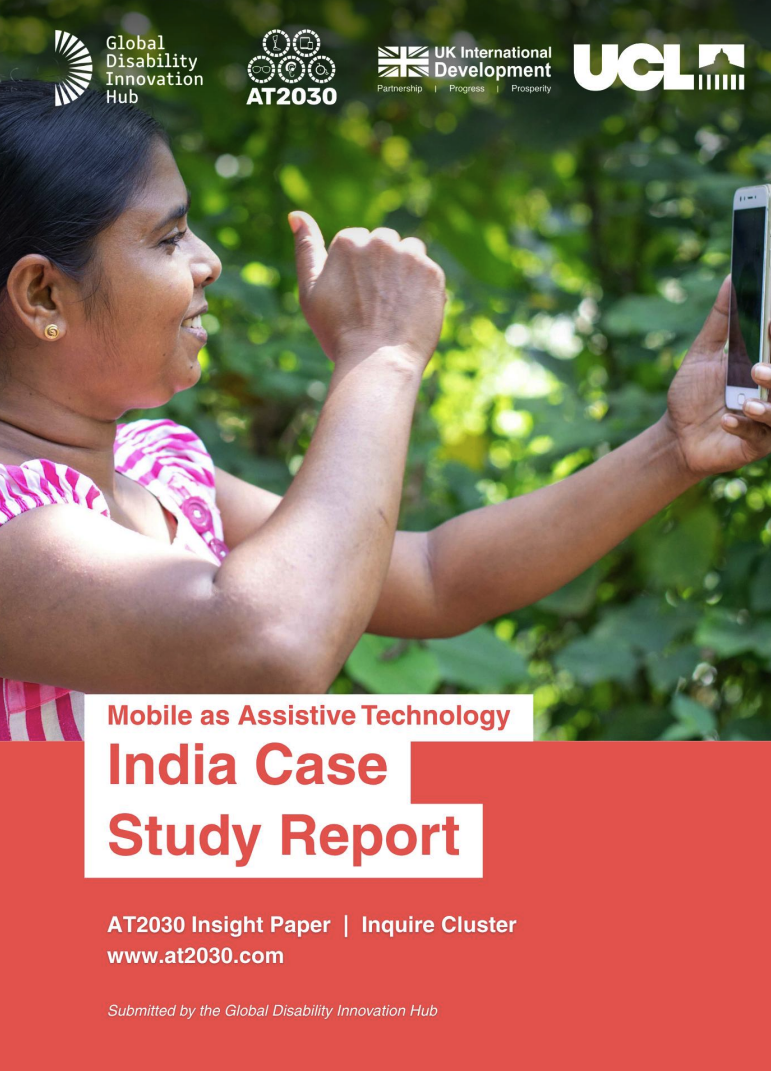
Mobile as Assistive Technology India Case Study Report
Global Disability Innovation HubMarch 31, 2026IndiaAcademic Research PublicationsThis summary presents findings from a 12-month research study conducted by the Centre for Accessibility in the Global South (CAGS) at IIIT Bangalore, in partnership with the Global Disability Innovation Hub (GDI Hub) at University College London. The study examined the potential of Android smartphones to function as assistive technology (AT) for people with visual and hearing impairments in India.
-
2026 Advance awardees
Royal Academy of EngineeringMarch 31, 2026GlobalCase Studies and ReportsAdvance 2026 will work towards the theme of 'Accessibility, Assistive and Inclusive Technologies’ during the 2025 to 2026 period. Advance 2026 is a collaboration between the Royal Academy of Engineering and Global Disability Innovation Hub, part of the AT2030 programme, which is funded by UK International Development.
-
Pathways to Funding For Organisations of Persons with Disabilities in Low- and-Middle-Income Countries
Global Disability Innovation Hub, Rebecca Joskow, Anna Landre, Pollyanna WardropMarch 31, 2026GlobalAcademic Research PublicationsOrganisations of Persons with Disabilities (OPDs) play vital roles as policy and governance experts, strategic partners, advocates, and community implementers of work to progress equity and inclusion of people with disabilities, including accelerating access to assistive technology. Despite their integral role in disability rights advocacy, many OPDs operate with minimal and insecure funding, undermining their ability to sustain operations, be involved in, and have influence over the shaping of strategies, policies, and interventions.
-
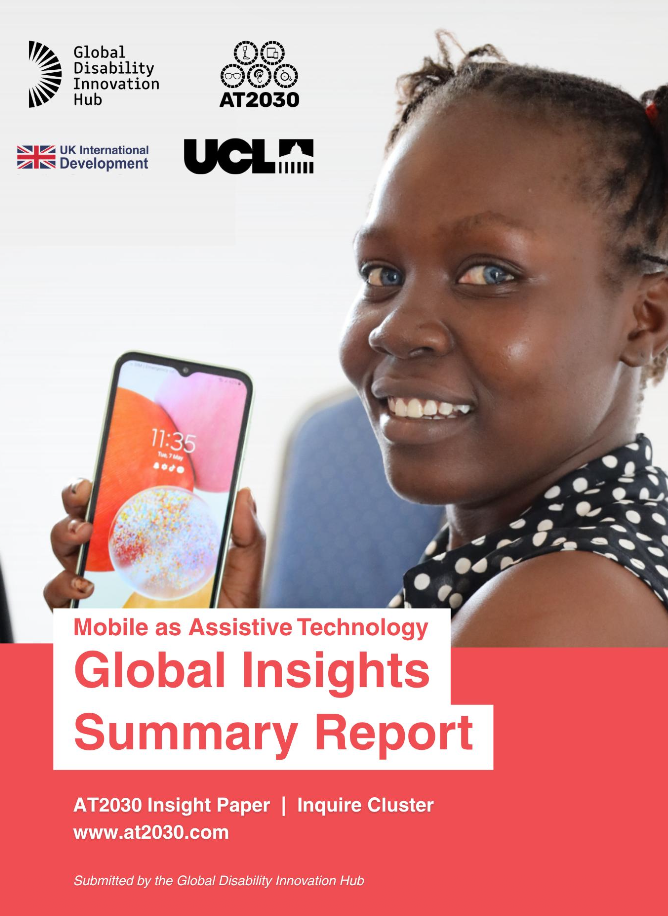
Global Insights Summary report
Global Disability Innovation HubMarch 31, 2026GlobalAcademic Research PublicationsSmartphones now contain screen readers, magnification tools, live captions, real-time transcription, and navigation features that can perform many of the functions of traditional assistive products. Across low- and middle-income countries (LMICs), people with disabilities are using these built-in features as their primary assistive technology, often because specialist AT is unavailable, unaffordable, or absent.
-
Mobile as Assistive Technology Kenya Report Summary
Global Disability Innovation HubMarch 30, 2026KenyaCase Studies and ReportsThis document presents the summary of findings from research investigating the impact of Mobile as Assistive Technology conducted in Kenya between 2024 and 2025. The project explored whether smartphones can serve as assistive technology for people who are Blind or Partially Sighted (BPS) and people who are Deaf or Hard of Hearing (DHH). The research was funded by the UK Department for International Development, Google, and ATScale – Global Partnership for Assistive Technology. The research was led by Global Disability Innovation Hub (GDI Hub) and University College London in collaboration with Jomo Kenyatta University of Agriculture and Technology, Kilimanjaro Blind Trust Africa, Senses Hub, and Safaricom.
-
Strengthening Organizations of Persons with Disabilities (OPDs) through Assistive Technology
Kilimanjaro Blind TrustMarch 30, 2026AT2030 ResourcesOrganizations of Persons with Disabilities (OPDs) are central to advancing inclusive governance and development in Kenya. Evidence across counties consistently shows that OPDs are already playing critical roles, linking communities to services, supporting participation in governance processes, and strengthening accountability at local and national levels. This strategy builds on what is already working and focuses on scaling, structuring, and sustaining the role of OPDs within Kenya’s development systems. There is a significant opportunity to further strengthen and formalize these contributions within formal systems.
-
Strengthening OPD Capacity for Inclusive Development in Mombasa County, Kenya
Kilimanjaro Blind TrustMarch 30, 2026KenyaCase Studies and ReportsDuring consultations in Mombasa, Jemima Kutata, an OPD leader, captures a recurring reality: while disability rights are increasingly recognised in law, translating these provisions into meaningful change at the community level remains a challenge. This reflects a broader gap between Kenya’s progressive legal frameworks, particularly the Persons with Disabilities Act, 2025, and their implementation in practice. In Mombasa, a coastal urban hub shaped by tourism, trade, and a large informal economy, persons with disabilities face distinct barriers in accessing services, employment, and assistive technologies. While Organisations of Persons with Disabilities (OPDs) play a critical role in addressing these gaps, many continue to face structural and capacity-related constraints that limit their influence.
-
Principles for inclusive event design
Royal Academy of EngineeringMarch 30, 2026AT2030 ResourcesInclusive events create opportunities for wider participation, stronger collaboration and richer discussions. This guide outlines practical steps to plan events that are inclusive by design and promote comfort, autonomy and inclusion. It is based on the experience and feedback gathered throughout the design and delivery of the AT2030 Frontiers symposium, which was part of a collaboration between the Royal Academy of Engineering and UCL Global Disability Inclusion (GDI) Hub’s AT2030 programme. AT2030 is funded by UK International Development.
-
Summary of the Device Evidence Compendium on Orthotics for WHO APL2 - Prosthetic Devices
Dr Ben OldfreyMarch 30, 2026GlobalAT2030 ResourcesSummary of the Device Evidence Compendium on Orthotics for WHO APL2 - Prosthetic Devices This document forms part of the AT2030 programme’s contribution to the WHO Assistive Product List (APL) 2 development process, delivered by the International Society of Prosthetics and Orthotics (ISPO) in collaboration with the Global Disability Innovation Hub. The document is not intended as a clinical guideline or technology recommendation. Instead, it functions as an evidence scaffold: consolidating what is currently known about need, benefits, risks, and use patterns, while clearly identifying evidence gaps relevant to global health, particularly in low‑ and middle‑income settings.
-
A Critical Review of Sexuality, Technology and Disability
Patel Dilisha, Ekat Osipova, Dr Giulia Barbareschi, Katta SpielMarch 30, 2026GlobalAcademic Research PublicationsThe investigation of technologies facilitating sexual interactions and sexuality-related explorations is becoming more established in Human-Computer Interaction (HCI), albeit with little systematic attention to the sexual lives of disabled people. In this space, we undertook a literature review utilising feminist content analysis to take stock and critically analyse the domains of sexuality, technology and disability when they intersect. Our approach aligns with the broader goals of promoting inclusivity, diversity, and equity in technology design and application. We present a descriptive and analytical outline of existing research on sexuality, technology and disability through which we identified unmarked norms governing research.
-
Summary of the Device Evidence Compendium on Orthotics for WHO APL2 - Orthotic Devices
Dr Ben OldfreyMarch 30, 2026GlobalAT2030 ResourcesSummary of the Device Evidence Compendium on Orthotics for WHO APL2 - Orthotic Devices This document forms part of the AT2030 programme’s contribution to the WHO Assistive Product List (APL) 2 development process, delivered by the International Society of Prosthetics and Orthotics (ISPO) in collaboration with the Global Disability Innovation Hub. The document provides structured evidence summaries across a wide range of externally worn orthotic devices, following a consistent framework aligned with WHO APL2 requirements.
-
Channelling, Coordinating, Collaborating: A Three-Layer Framework for Disability-Centered Human-Agent Collaboration
Catherine Holloway, Lan XiaoMarch 27, 2026Academic Research PublicationsAI accessibility tools have mostly been designed for individual use, helping one person overcome a specific functional barrier. But for many people with disabilities, complex tasks are accomplished through collaboration with others who bring complementary abilities, not solitary effort. We propose a three-layer framework, Channelling, Coordinating, and Co-Creating, that rethinks AI's role in ability-diverse collaboration: establishing shared informational ground across abilities, mediating workflows between collaborators with different abilities, and contributing as a bounded partner toward shared goals. Grounded in the Ability-Diverse Collaboration framework, grounding theory, and Carlile's 3T framework, it extends the ``agents as remote collaborators'' vision by centring the collaborative, interdependent ways people with disabilities already work.
-
Mobile as Assistive Technology Brazil Report Summary
Global Disability Innovation HubMarch 27, 2026BrazilAcademic Research PublicationsThis document presents the summary of findings from research investigating the impact of Mobile as Assistive Technology conducted in Brazil between 2024 and 2025. The project explored whether smartphones can serve as assistive technology for people who are Blind or Partially Sighted (BPS) and people who are Deaf or Hard of Hearing (DHH). The research was funded by the UK Department for International Development, Google, and ATScale – Global Partnership for Assistive Technology.
-
OPD Capacity Strengthening Framework (Kenya)
Kilimanjaro Blind TrustMarch 27, 2026KenyaCase Studies and ReportsThis framework provides a structured and evidence-informed approach to strengthening the institutional, technical, and operational capacity of OPDs in Kenya. It prioritizes the integration of Adaptive Assistive Technology (AT) as an enabler of inclusion and organizational effectiveness, while also advancing inclusive leadership and governance, strategic partnerships, sustainable resource mobilization, and accountable, results-oriented project implementation.
-
AT2030 Venture Spotlight Series featuring Shonaquip
Global Disability Innovation HubMarch 26, 2026Case Studies and ReportsShonaquip is a South Africa-based social enterprise working at the intersection of assistive technology, disability inclusion, and systems change. Over more than 30 years, they have developed an approach shaped by a simple reality: providing a device is not enough. Their work spans the design and manufacturing of mobility and posture support devices, alongside clinical services, training, and long-term engagement with the systems that determine whether those devices are used safely and effectively over time.
-
AT2030 Venture Spotlight Series featuring DeafTawk
Global Disability Innovation HubMarch 26, 2026Case Studies and ReportsDeafTawk operates a platform for real-time sign language interpretation, designed to make communication access more immediate and reliable. Operating across multiple countries, the company connects Deaf users to qualified interpreters via mobile video, reducing the need for advance booking and enabling access in situations where support is often unavailable. Their work focuses on addressing the gaps in how interpretation services are delivered today,across healthcare, employment, and public services, while building toward a model where technology can extend access alongside human interpreters.
-
AT2030 Venture Spotlight Series featuring JOGO Health
Global Disability Innovation HubMarch 26, 2026Case Studies and ReportsJOGO Health is a digital therapeutics company developing a platform for chronic pain and neuromuscular conditions that aims to reduce reliance on medication and invasive procedures. Operating across the US and India, the company combines wearable muscle sensors, guided therapy, and remote clinician oversight to support ongoing treatment beyond the clinic. Their work focuses on extending care between appointments, enabling patients to continue structured therapy at home while remaining connected to their clinical team. In doing so, JOGO responds to a growing need for non-pharmacological approaches to long-term condition management.
-
AT2030 Venture Spotlight Series featuring SynPhNe
Global Disability Innovation HubMarch 26, 2026Case Studies and ReportsSynPhNe is a neurological rehabilitation company developing technology to deliver high-intensity, personalised therapy for stroke and other neurological conditions. Founded in Singapore and extending to the US and India markets, the company has built a platform that captures brain and muscle signals in real time to guide recovery. Their work focuses on extending effective rehabilitation beyond specialist clinical settings, enabling structured, data-driven therapy in both clinics and home environments.
-
AT2030 Venture Spotlight Series featuring Thinkerbell Labs
Global Disability Innovation HubMarch 26, 2026Case Studies and ReportsThinkerbell Labs is a disability-tech social enterprise focused on how children with visual impairments learn to read. Their core product, Annie, is designed so that children can learn Braille and early literacy more independently, without needing a specialist teacher at every moment. Recognised as one of Time Magazine’s Best Inventions (2022), Annie is now used in over 300 centres across 26 Indian states and has supported more than 10,000 children. The model is beginning to extend internationally through partnerships with schools and distributors.
-
Harmonising assistive technology access data for evidence-based decision-making: guidance and implications
Vicki Austin, Catherine Holloway, Jamie DanemayerMarch 26, 2026GlobalAcademic Research PublicationsPopulation ageing demands that governments plan proactively for a growing number of older people and an increasing demand for products and services that enable their independence and participation. This article is structured as follows: first, the authors introduce the importance of harmonisation in the AT data space and the overall aims of this proposal. The Methods describe how commonly used, nonidentical AT assessment modules may be harmonised in practice, using the proposed logic. Implications of the broad applications of this logic are described, in terms of research and innovation, new data collection, and policy decision-making. Finally, a reflection on the limitations of this logic and the potential for harmonisation to improve evidence-based decision-making in the AT sector conclude this.
Previous PageNext Page