Publications
-
Designing an Inclusive Energy Innovation Network - What Works in Practice?
Global Disability Innovation HubAug. 28, 2026Case Studies and ReportsThis case study captures early insights from eight innovation partnerships formed between actors from the clean energy and assistive technology sectors. Facilitated by the Global Disability Innovation Hub (GDI Hub), the intervention drew on the networks, partnerships, and ecosystem-building approaches developed through AT2030, GDI Hub’s flagship programme funded by UK aid, and wider disability innovation initiatives to connect stakeholders who would not typically operate within the same innovation ecosystem.
-
Liberia National Priority Assistive Products List (APL)
Clinton Health Access Initiative, Ministry of Health, LiberiaJuly 27, 2026LiberiaAcademic Research PublicationsLiberia’s first National Priority Assistive Products List (APL) is evidence of the Government of Liberia’s commitment to increasing access to assistive technology (AT) through strengthening governance and coordination in the sector. The APL is intended to guide the AT sector in procurement, donation, service provider training, development of technical standards and service delivery guidelines, and broader advocacy and resource mobilisation efforts. T
-
Dot Glasses Field Trial Template Pack
Dot GlassesJuly 8, 2026KenyaAT2030 ResourcesDot Glasses Field Trial Template Pack
-
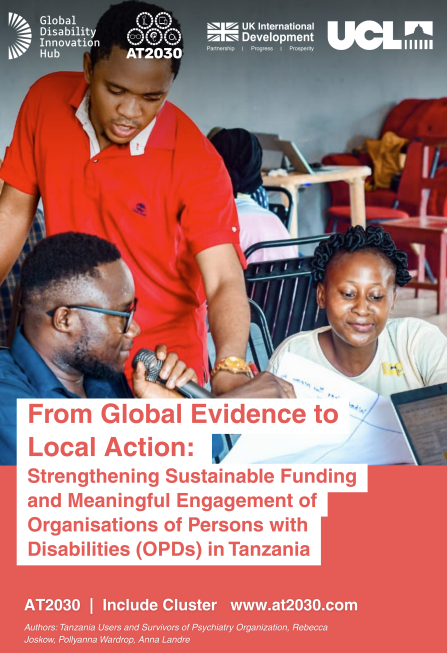
From Global Evidence to Local Action: Strengthening Sustainable Funding and Meaningful Engagement of Organisations with Disabilities (OPDs) in Tanzania
Tanzania Users and Survivors of Psychiatry Organization, Rebecca Joskow, Anna Landre, Pollyanna WardropJune 30, 2026TanzaniaCase Studies and ReportsThe Tanzania Users and Survivors of Psychiatry Organisation (TUSPO), a national membership movement of persons with psychosocial disabilities, was one of the eight OPD partners in the 'Pathways to Funding for OPDs in LMICs' work. Following the publications, TUSPO met with OPDs and policy stakeholders across the disability funding ecosystem in Tanzania. This paper describes the process, outputs and outcomes from TUSPO doing so.
-
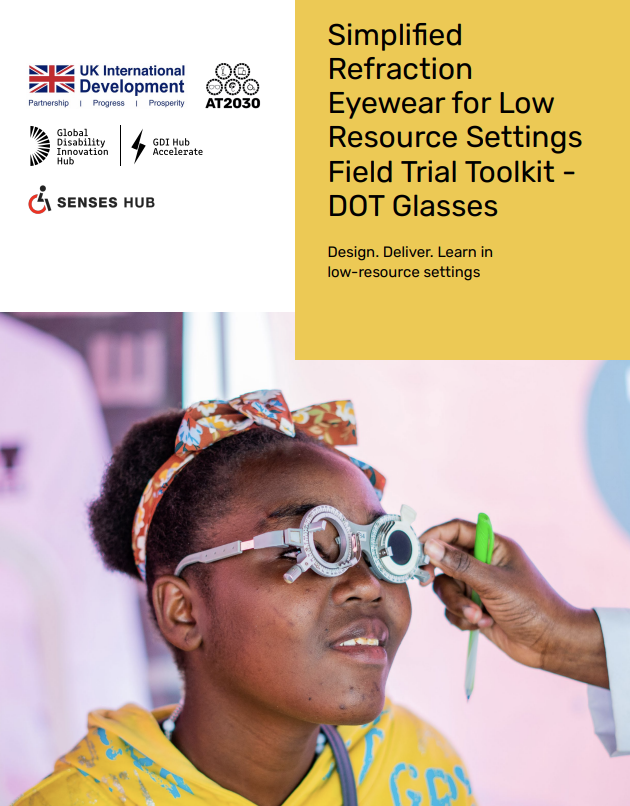
Simplified Refraction Eyewear for Low Resource Settings Field Trial Toolkit.
Dot GlassesJune 30, 2026KenyaCase Studies and ReportsThis toolkit is a practical guide for delivering simplified refraction eyewear in low-resource settings. It draws on a field trial conducted across seven community sites in Nairobi and Kiambu Counties in June August 2025. It is designed to help teams: • deliver vision camps safely and efficiently • maintain protocol and data quality • generate evidence that supports real decisions about scale. This toolkit focuses on how to deliver. It covers field operations, ethics and safeguarding, monitoring, and partner roles, based on what worked in practice.
-
Pathways to Funding For Organisations of Persons with Disabilities in Low- and-Middle-Income Countries.
Rebecca Joskow, Anna Landre, Pollyanna WardropJune 30, 2026Case Studies and ReportsOrganisations of Persons with Disabilities (OPDs) play important roles as policy and governance experts, strategic partners, and advocates for the inclusion of people with disabilities, including speeding up access to assistive technology. Despite this central role in disability rights advocacy, many OPDs work with limited funding. This weakens their ability to continue their work, and to influence the shaping of strategies, policies, and interventions. This report is a plain text translation of the Pathways to Funding report which set out to map the current funding environment for OPDs in low- and middle-income countries (LMICs).
-
Why Climate Change Hits Disabled People Harder
UCL Grand Challenge, Global Disability Innovation HubJune 30, 2026GlobalCase Studies and ReportsPeople with disabilities are among those most affected by climate change, yet they are often excluded from climate planning, design, and emergency response. During London Climate Action Week, we spoke with researchers behind a UCL Grand Challenges-funded and AT2030 funded project exploring how disability-inclusive approaches can strengthen climate resilience and create fairer, more effective solutions. Led by Iain McKinnon and Liza Griffin, the project brings together researchers, practitioners and disabled people to examine how assistive technology, inclusive design and cross-sector collaboration can shape climate action.
-
Seeing Clearly: The Impact of Affordable Eyeglasses on Daily Life in Kenya
Global Disability Innovation Hub, Dot Glasses, Senses HubJune 29, 2026KenyaCase Studies and ReportsThe report draws on survey, questionnaire, and interview data from people who received eyeglasses through the trial. Participants reported meaningful improvements in daily activities such as reading, phone use, schoolwork, and mobility, alongside increased independence and confidence. Experiences were not uniform: some participants reported discomfort or more modest benefits, and a small minority reported no improvement or reduced independence
-
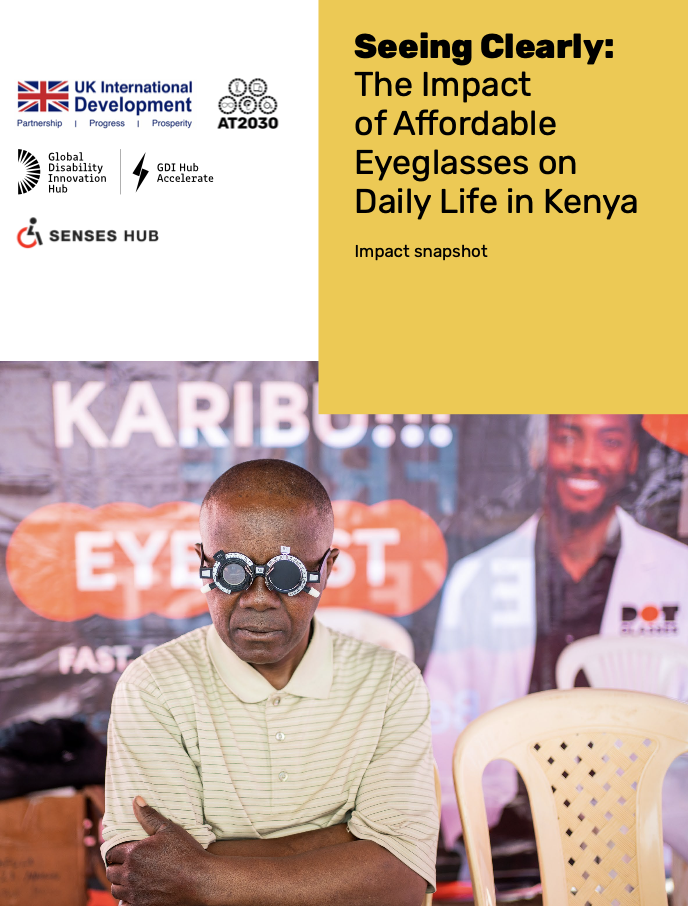
Seeing Clearly: The Impact of Affordable Eyeglasses on Daily Life in Kenya
Dot GlassesJune 29, 2026KenyaAT2030 ResourcesThe report draws on survey, questionnaire, and interview data from people who received eyeglasses through the trial. Participants reported meaningful improvements in daily activities such as reading, phone use, schoolwork, and mobility, alongside increased independence and confidence. Experiences were not uniform: some participants reported discomfort or more modest benefits, and a small minority reported no improvement or reduced independence
-
Simplified Refraction Eyewear for Low Resource Settings Field Trial Toolkit - DOT Glasses
Global Disability Innovation Hub, Dot Glasses, Senses HubJune 25, 2026KenyaCase Studies and ReportsThis toolkit is a practical guide for delivering simplified refraction eyewear in low-resource settings. It draws on a field trial conducted across seven community sites in Nairobi and Kiambu Counties from June to August 2025. It is designed to help teams: • deliver vision camps safely and efficiently • maintain protocol and data quality • generate evidence that supports real decisions about scale. This toolkit focuses on how to deliver. It covers field operations, ethics and safeguarding, monitoring, and partner roles, based on what worked in practice.
-
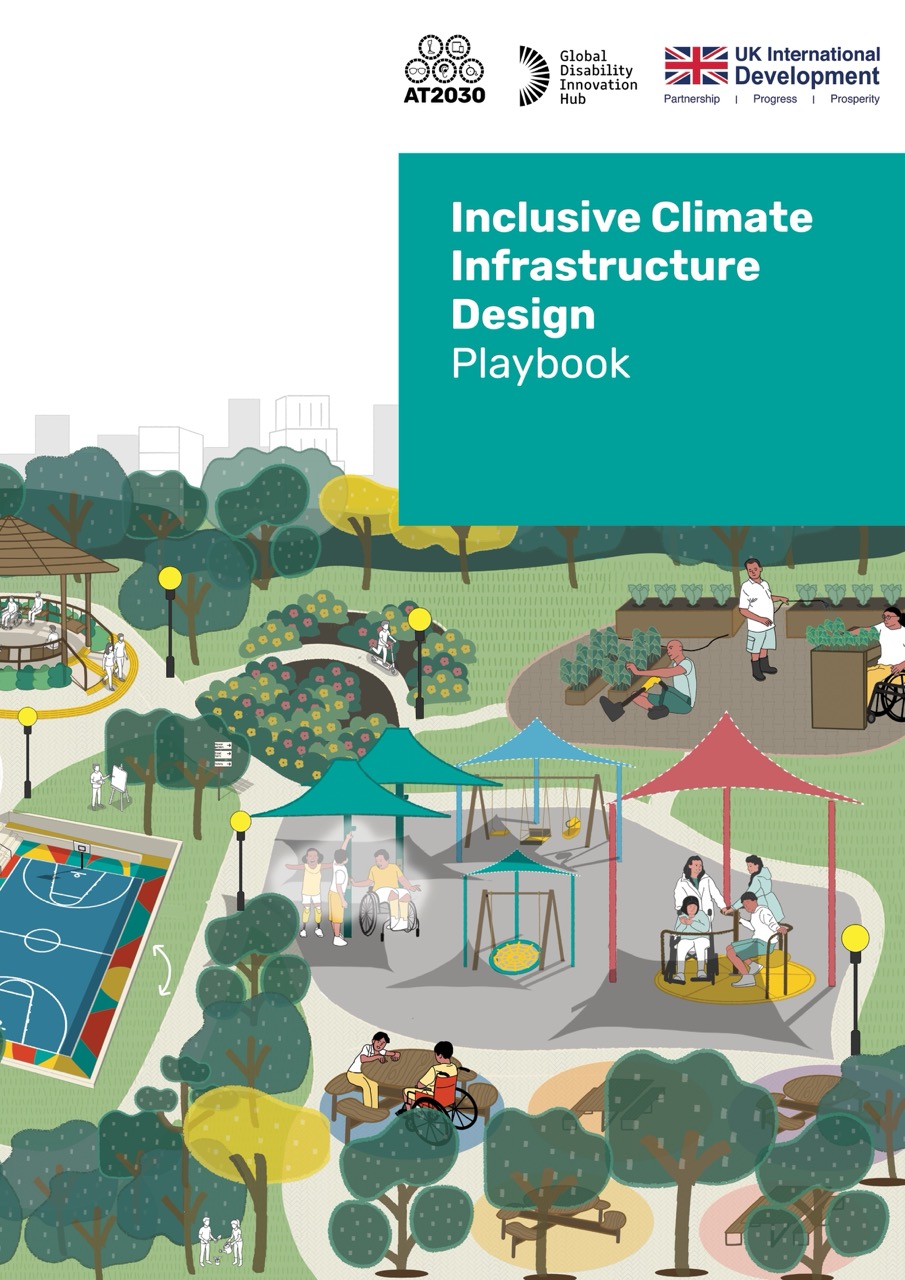
Inclusive Climate Infrastructure Design Playbook
Global Disability Innovation HubJune 23, 2026GlobalAT2030 ResourcesInclusive climate infrastructure design is an approach to co-designing physical spaces, services, and systems that anticipate, prepare for, and adapt to changing climate conditions while simultaneously enabling accessibility and equal participation for all people, particularly people with disabilities. Such infrastructure can prevent, absorb, recover from, and adapt to disruptions caused by current and future climate risks while strengthening the resilience capacity of people with disabilities.
-
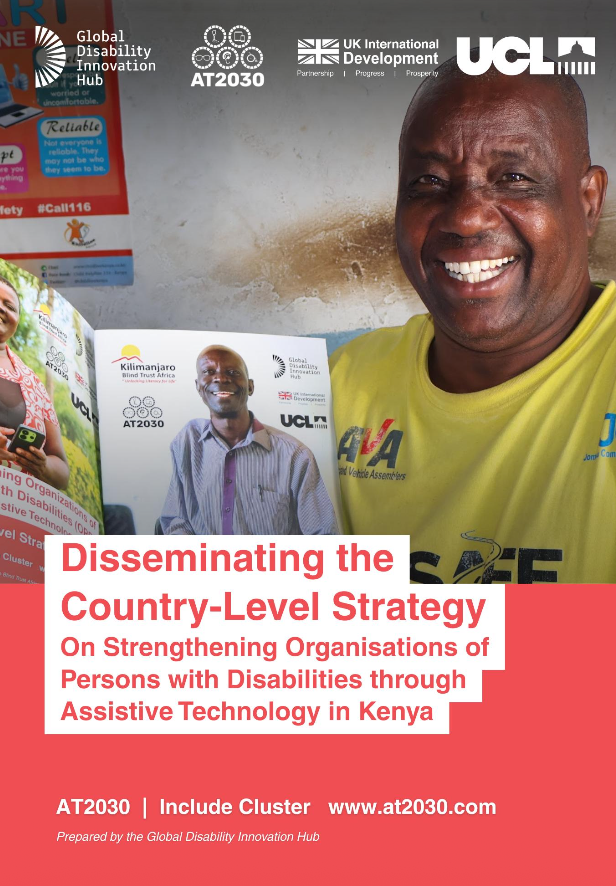
Disseminating the Country-Level Strategy on Strengthening Organisations of Persons with Disabilities through Assistive Technology in Kenya.
Global Disability Innovation Hub, Kilimanjaro Blind TrustJune 23, 2026AT2030 ResourcesKilimanjaro Blind Trust Africa (KBTA), through the AT2030 Programme led by the Global Disability Innovation Hub (GDI Hub), organised a national dissemination event to present the Country-Level Strategy on Strengthening Organisations of Persons with Disabilities (OPDs) through Assistive Technology in Kenya. KBTA developed the strategy following a comprehensive needs assessment conducted in Nairobi, Kisumu, and Mombasa Counties and consultations with OPDs, government institutions, development partners, researchers, and Assistive Technology stakeholders.
-
Project Euphonia: advancing inclusive speech recognition through expanded data collection and evaluation
Centre for Digital Language InclusionJune 20, 2026GlobalAcademic Research PublicationsSpeech recognition models, predominantly trained on standard speech, often exhibit lower accuracy for individuals with accents, dialects, or speech impairments. This disparity is particularly pronounced for economically or socially marginalized communities, including those with disabilities or diverse linguistic backgrounds. Project Euphonia, a Google initiative originally launched in English dedicated to improving Automatic Speech Recognition (ASR) of disordered speech, is expanding its data collection and evaluation efforts to include international languages like Spanish, Japanese, French and Hindi, in a continued effort to enhance inclusivity. This paper presents an overview of the extension of processes and methods used for English data collection to more languages and locales, progress on the collected data, and details about our model evaluation process, focusing on meaning preservation based on Generative AI.
-
A review of assistive product prices in 12 countries
Johan Borg, Irene Calvo, Vinicius Delgado RamosApril 29, 2026GlobalAcademic Research PublicationsThe World Health Organization (WHO) and the United Nations Children's Fund (UNICEF) estimate that over 2.5 billion people need assistive technology, yet access remains limited. In response to this pressing need, WHO has maintained, since 2016, a Priority Assistive Products List (APL) with 50 priority assistive products. In 2024, an update was launched to revise and expand the list based on new evidence and stakeholder input. This paper presents the price review component of the update. The review consisted of collecting global price data and classifying assistive products into price ranges to support the decision-making process for the updated APL.
-
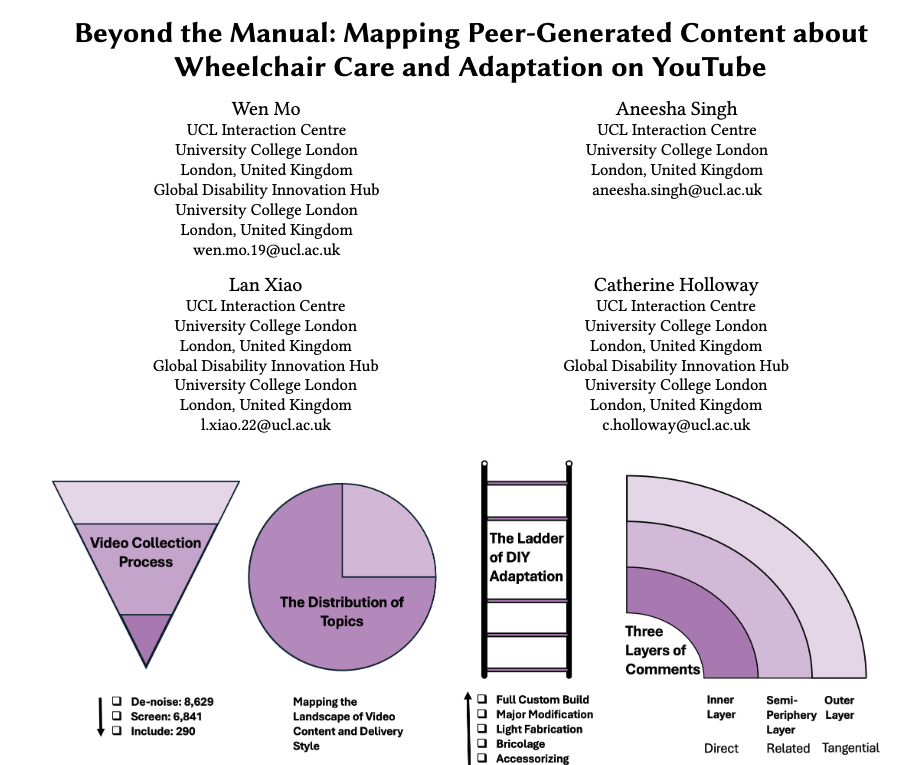
Beyond the Manual: Mapping Peer-Generated Content about Wheelchair Care and Adaptation on YouTube
Wen Mo, Catherine Holloway, Lan Xiao, Aneesha SinghApril 13, 2026GlobalAcademic Research PublicationsWheelchair users often face significant barriers to maintaining and adapting their chairs, from resource constraints to limited access to professional services. In response, many turn to social media platforms such as YouTube to share and learn practical knowledge. However, little is known about how wheelchair users document and exchange repair, maintenance, and customization practices online. To address this gap, we analyzed 290 YouTube videos alongside 800 sampled comments using thematic coding and statistical analysis.
-
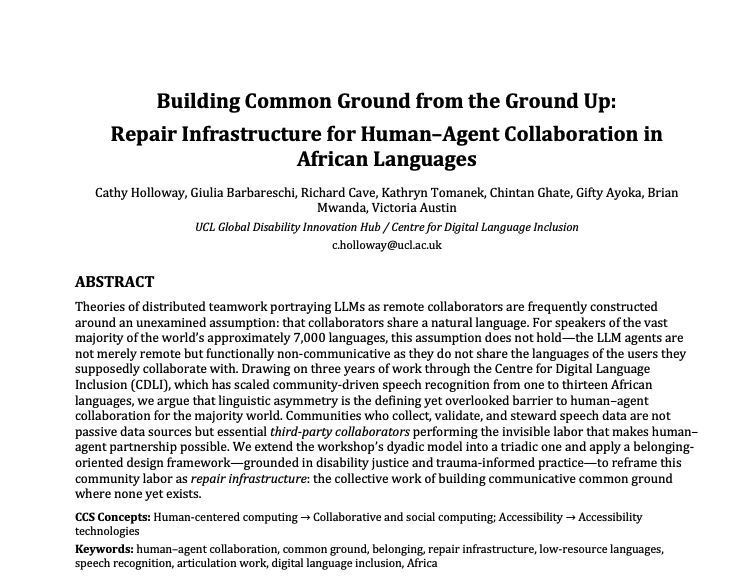
Building Common Ground from the Ground Up: Repair Infrastructure for Human–Agent Collaboration in African Languages
Gifty Ayoka, Vicki Austin, Catherine Holloway, Dr Giulia Barbareschi, Katrin Angerbauer, Richard CaveApril 13, 2026Academic Research PublicationsTheories of distributed teamwork portraying LLMs as remote collaborators are frequently constructed around an unexamined assumption: that collaborators share a natural language. For speakers of the vast majority of the world’s approximately 7,000 languages, this assumption does not hold—the LLM agents are not merely remote but functionally non-communicative as they do not share the languages of the users they supposedly collaborate with. Drawing on three years of work through the Centre for Digital Language Inclusion (CDLI), which has scaled community-driven speech recognition from one to thirteen African languages, we argue that linguistic asymmetry is the defining yet overlooked barrier to human–agent collaboration for the majority world.
-
Access to funding: Good practice guidance from & for OPDs - Easy Read
Global Disability Innovation HubApril 1, 2026GlobalAT2030 ResourcesWe want to help OPDs do their important work making things fairer for disabled people. This document shares advice from OPDs around the world. We hope it will help you get funding for your OPD.
-
Mobile as Assistive Technology Brazil Case Study Report
Global Disability Innovation HubMarch 31, 2026BrazilAcademic Research PublicationsThis study investigated the feasibility and impact of providing smartphones and digital skills training to people with visual and hearing impairments in Brazil, a country where over 84% of the population uses the internet, but a significant digital divide persists for those with disabilities.
-
Mobile as Assistive Technology Kenya Case Study Report
Global Disability Innovation HubMarch 31, 2026KenyaCase Studies and ReportsMobile phones are increasingly important to our lives. They can connect people to learning and employment opportunities and support social and cultural interactions. Mobile phones have also been identified as assistive technology in prior AT2030 research. However, mobile phones and the Internet are often excluded from Government or Insurance-based assistive technology provision schemes in low- and middle-income countries. There is insufficient evidence to explain how mobile phones function as assistive technologies and what support is needed for people to learn the full suite of accessibility features on mobile devices.
-
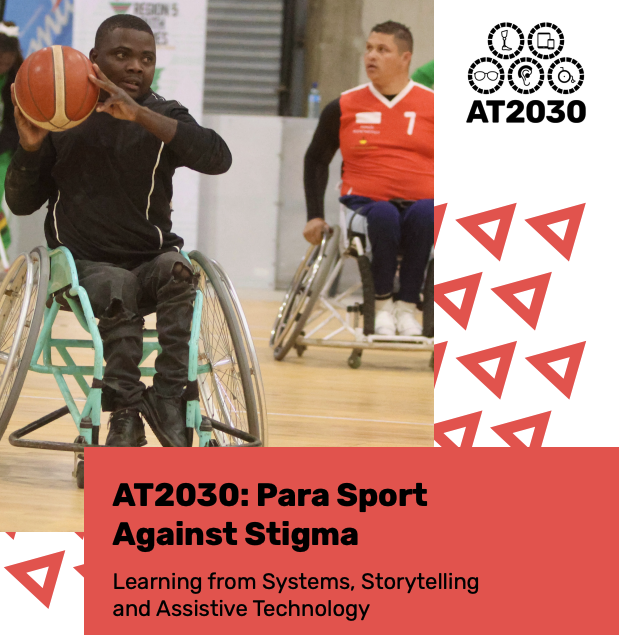
AT2030: Para Sport Against Stigma Learning from Systems, Storytelling and Assistive Technology
Global Disability Innovation HubMarch 31, 2026Malawi, United KingdomCase Studies and ReportsThe AT2030 Para Sport Against Stigma Programme is a multi-phase research and practice initiative funded by UK International Development and led by Loughborough University in partnership with organisations across Southern Africa. It explored how Para Sport, media, storytelling, and assistive technology could work together to challenge disability stigma and evolved through cycles of reflection and learning shifting from an early focus on broadcast access and Paralympic visibility toward a deeper understanding of how stigma is structurally reproduced through systems, and what it actually takes to enable participation.
Next Page